







A look at how solar gets designed and installed across Ontario for businesses, warehouses, farms, and homes. These are representative use cases that show how we approach different sites, loads, and goals.
A look at how solar gets designed and installed across Ontario for businesses, warehouses, farms, and homes. These are representative use cases that show how we approach different sites, loads, and goals.
A distribution centre, a foundry, a greenhouse, and a family home each draw power in a completely different rhythm and a system only pays back when it’s engineered around that rhythm. Here’s how that thinking applies across the buildings we design for.
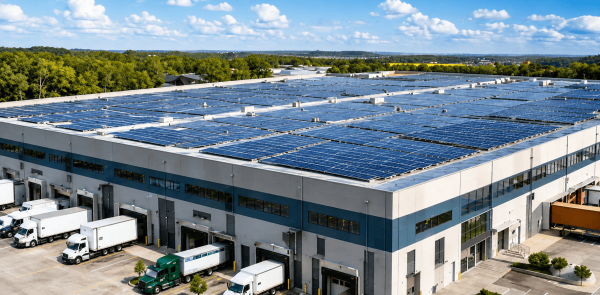
Few buildings are better suited to solar than a warehouse. They run conveyors, dock equipment, high-bay lighting, and climate control through long operating days, which means a steady daytime electricity draw. They sit under some of the largest unobstructed flat roofs in commercial real estate, usually doing nothing.
The natural approach is a ballasted flat-roof array that needs no roof penetrations, sized to offset that daytime base load as commercial rooftop solar in Ontario built around how the facility actually operates. Because the power is consumed on-site, it’s classic behind-the-meter solar: every kilowatt-hour generated is one not bought from the grid at a rising rate. Where the facility carries sharp demand peaks, battery storage can be layered in to shave those peaks, and many sites add EV or forklift charging as the fleet electrifies.
It’s a strong fit for solar for warehouses in Ontario, and the project type the Save on Energy retrofit incentive was designed around.
Manufacturing runs on intense, continuous power, and Ontario’s commercial tariffs punish the peaks hardest, demand charges alone can dominate a factory’s bill.
The approach here is about more than offset: a rooftop or ground-mount array is sized to the plant’s daytime production load, and battery storage is used strategically to discharge during peak windows, directly trimming the demand charges that solar offset alone can’t touch.
This is where load displacement solar earns its keep, matching generation to the hours the line is busiest. Solar for factories in Ontario also demands rigorous electrical engineering, three-phase integration, proper disconnects, and ESA-standard work so the system commissions cleanly and starts producing without interconnection delays.
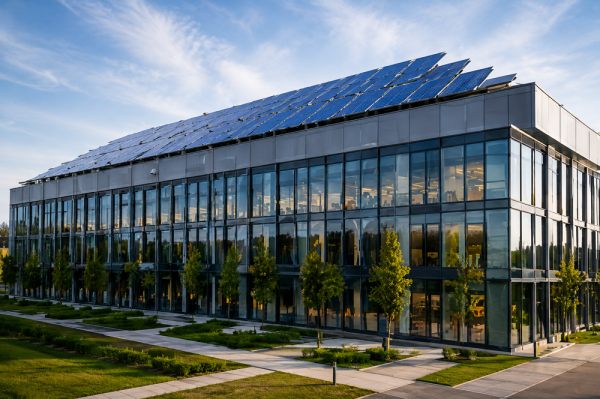
For a landlord or building owner, a roof is usually a liability to insure and repair. Solar turns it into a producing asset. On a multi-storey office or mixed-use building, an east-west panel configuration spreads generation across the full working day rather than concentrating it at noon, which lines up better with how a tenanted building consumes power.
Beyond lowering common-area energy costs, this kind of project adds measurable value: lower operating costs make a building more attractive to tenants and buyers, and on-site generation supports the ESG and sustainability targets that increasingly drive commercial leasing decisions. It’s solar for commercial buildings in Ontario treated as a real-estate investment, not just an energy upgrade.
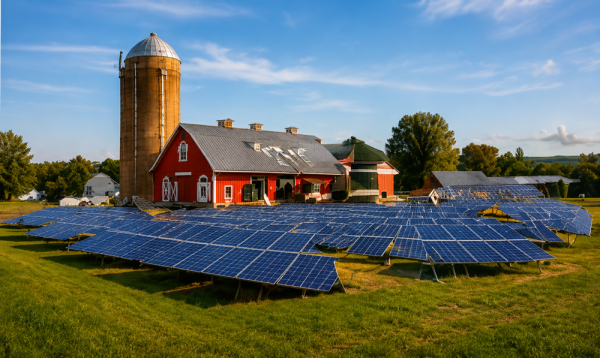
Farms are surprisingly power-hungry; barns, ventilation, irrigation, grain drying, and cold storage all draw heavily, often in areas where grid reliability is weaker and outages cost real money. With generous roof space and open land, agricultural sites can support rooftop arrays, ground-mount systems, or both.
Where resilience matters as much as savings, pairing the array with a battery bank keeps critical loads running through outages rather than relying solely on the grid. Solar for agricultural facilities in Ontario is also fully eligible for the major business incentive programs, which improves the economics for operations watching every input cost.
Every scenario above started the same way: by looking closely at one specific site, its load, and its goals. The only way to know what solar looks like for your facility or home is to model it against your real numbers, which we’ll do free and with no obligation.

We are a Brampton based solar firm that provides commercial and home solar solutions to Ontario homeowners and businesses.
By appointment only
(We reply within 24 hours)
We are a Brampton based solar firm that provides commercial and home solar solutions to Ontario homeowners and businesses.
By appointment only
(We reply within 24 hours)