


Ontario SOlar Incentives
Choose The Right
Ontario Solar Incentives
For Your Business
The programs that turn a commercial solar project from a capital cost into a returning asset include federal tax credits, accelerated write-offs, and the province’s Save on Energy retrofit incentive. They change often and the best ones run out of funding, so we confirm exactly what your business qualifies for today and file every application on your behalf.
Expert Guidance
Application Support
Real Savings
Talk to solar expert
647- 338-4560
Ontario wide service
Ontario Solar Incentives
Choose The Right
Ontario Solar Incentives
For Your Business
The programs that turn a commercial solar project from a capital cost into a returning asset include federal tax credits, accelerated write-offs, and the province’s Save on Energy retrofit incentive. They change often and the best ones run out of funding, so we confirm exactly what your business qualifies for today and file every application on your behalf.
Expert Guidance
Application Support
Real Savings
SOLAR INCENTIVES FOR BUSINESSES IN ONTARIO
For a business, the solar incentives for businesses in Ontario aren't a minor discount.
Stacked correctly, they can recover a large share of your total solar installation cost in Ontario. Here’s each one in full, and exactly who it’s for.


Clean Technology ITC
30% refundable
The single biggest lever on commercial payback. It returns 30% of the capital cost of eligible solar and battery equipment as a refundable credit paid out even if it exceeds your tax owing for property available for use through December 31, 2033, dropping to 15% in 2034 and ending after. It’s available to taxable Canadian corporations and REITs, not individual homeowners. One condition worth planning for: if you don’t elect to meet the federal labour requirements, the rate falls by 10 points to 20%. Among the solar PV incentives in Ontario, this is the one that most reshapes a business case.
Clean Technology ITC
30% refundable
The single biggest lever on commercial payback. It returns 30% of the capital cost of eligible solar and battery equipment as a refundable credit paid out even if it exceeds your tax owing for property available for use through December 31, 2033, dropping to 15% in 2034 and ending after. It’s available to taxable Canadian corporations and REITs, not individual homeowners. One condition worth planning for: if you don’t elect to meet the federal labour requirements, the rate falls by 10 points to 20%. Among the solar PV incentives in Ontario, this is the one that most reshapes a business case.

Save on Energy Retrofit
Up to $860/kW
The Solar Retrofit Program in Ontario, administered by the IESO, pays a per-kilowatt incentive for behind-the-meter rooftop solar. Micro systems up to 10 kW earn $1,000/kW-DC; systems over 10 kW-AC up to 1 MW earn $860/kW-AC, capped at 50% of eligible project costs. Eligibility covers commercial, industrial, institutional, multi-residential, agricultural, and municipal buildings, but the prescriptive rate is for rooftop-mounted systems only as ground-mount doesn’t qualify. Two things make timing critical: the over-10 kW rate drops to $770/kW-AC on June 30, 2026, and an application must be submitted before you enter a binding commitment such as a purchase order. This is load displacement solar and taking the Retrofit incentive makes that system ineligible for a net-metering agreement.

Accelerated depreciation
On top of the credit, your business can depreciate the system far faster than ordinary equipment. Clean energy gear falls under CCA Classes 43.1 and 43.2 (30% and 50% declining balance), and recent legislation reinstates immediate (100%) expensing for eligible Class 43.1 property acquired after 2024 and available for use before 2030. Because this stacks on top of the ITC, these clean energy incentives in Ontario can transform first-year cash flow.

Net metering
For systems that export to the grid, including ground-mount, which is shut out of the Retrofit rate, net metering is the alternative. Established under O. Reg. 541/05, it credits surplus generation at the retail rate, though it pays in bill credits, not cash, and unused credits expire after 12 months. It’s an either/or with the Retrofit incentive, so we model both and recommend the path with the stronger return.
How do they stack?
The reason commercial solar pencils out in Ontario is that the major government solar programs in Ontario are designed to layer.
Together, these Ontario energy incentives are why well-designed commercial systems commonly reach payback in the three-to-seven-year range, then deliver decades of effectively free power. We help you model your exact stack and your real numbers in a free feasibility study.
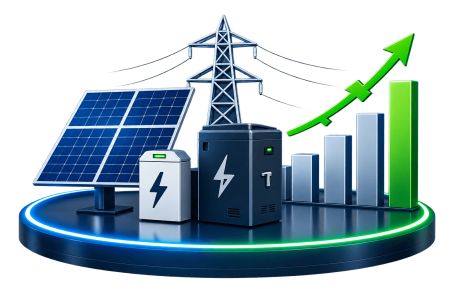
A typical business stack looks like this
Layer 1
Cut the upfront cost
The 30% Clean Technology ITC and the Save on Energy retrofit incentive both reduce what you actually pay for the system.

Layer 2
Accelerate the tax benefit
Accelerated depreciation lets you write the asset down quickly, pulling savings forward into year one.

Layer 3
Bank the ongoing savings
Every kilowatt-hour you self-generate is energy cost reduction in Ontario you keep for 25+ years, compounding as grid rates climb.


Cost & financing
Finance Smart. Save More.
Incentives cover a significant portion of the cost. Flexible financing options make solar accessible with little to no upfront investment.
$0-down financing
Spread the cost so the monthly energy savings help cover the payment from day one; the system works while it pays for itself.
Model my savings →
SOLAR INCENTIVES FOR HOMEOWNERS
Going solar at home? Here's your path.
Homeowners have their own set of Ontario solar rebates, though the choice is simpler and it’s an either/or.
We'll run both paths for your home and recommend whichever pays back faster.

Home Renovation Savings
$5,000
Solar Panels
+
$5,000
Battery Storage
Program Overview
Home Renovation Savings provides up to $5,000 toward solar panels plus up to $5,000 toward paired battery storage.
no energy assessment required for solar.
Load-displacement only.Cannot also use Net Metering.

Net metering
Bill Credits
+
Surplus Solar
Energy
Program Overview
Net Metering is the ideal option for homeowners who want to export surplus solar energy in Ontario and receive retail-rate bill credits on their electricity bill.
Good to Know
Choose either Net Metering or the Home Renovation Savings rebate, depending on which offers better value for your project.

INCENTIVE QUESTIONS ANSWERED FOR YOU
A commercial project can typically stack the federal 30% Clean Technology ITC, accelerated depreciation under Class 43.1/43.2, and the Save on Energy retrofit incentive; the three layers do different jobs and are designed to work together. The main exclusion to know: a system taking the Retrofit incentive can’t also net-meter. We map the optimal combination for your facility.
It depends on system size, roof, and tax position, but between the 30% refundable credit, the per-kilowatt retrofit incentive (up to 50% of eligible cost), and accelerated write-offs, the effective cost to a business lands well below sticker. We quantify your real commercial energy savings in Ontario and net cost in a free feasibility study before you commit to anything.
No. The Canada Greener Homes Loan is closed,its funding is fully committed and new applications can’t be approved, with the portal having shut on October 2, 2025. Existing approved loans are unaffected. For new projects we’ll point you to current options, including municipal PACE-style financing where available and our own financing.
Both have ended, microFIT closed to new applicants in 2017, and the Canada Greener Homes Grant closed in 2024. Today’s programs replace them: the Clean Technology ITC and Save on Energy retrofit for businesses, and the Home Renovation Savings rebate for homes.
Source: https://magsolar.ca/clean-technology-investment-tax-credit-ct-itc/
Yes. We confirm eligibility, prepare the documentation, and submit every application, including time-sensitive ones. For the Save on Energy retrofit specifically, a complete submission before June 30, 2026 locks in the higher $860/kW rate, so we move fast on those.